A century-proven way of teaching where children learn by doing — guided by trained teachers, hands-on materials, and their own natural curiosity.
Developed by Dr. Maria Montessori, the Montessori method is built on a simple observation: children are natural learners. Given the right environment and the right materials, they teach themselves — joyfully and at their own pace.
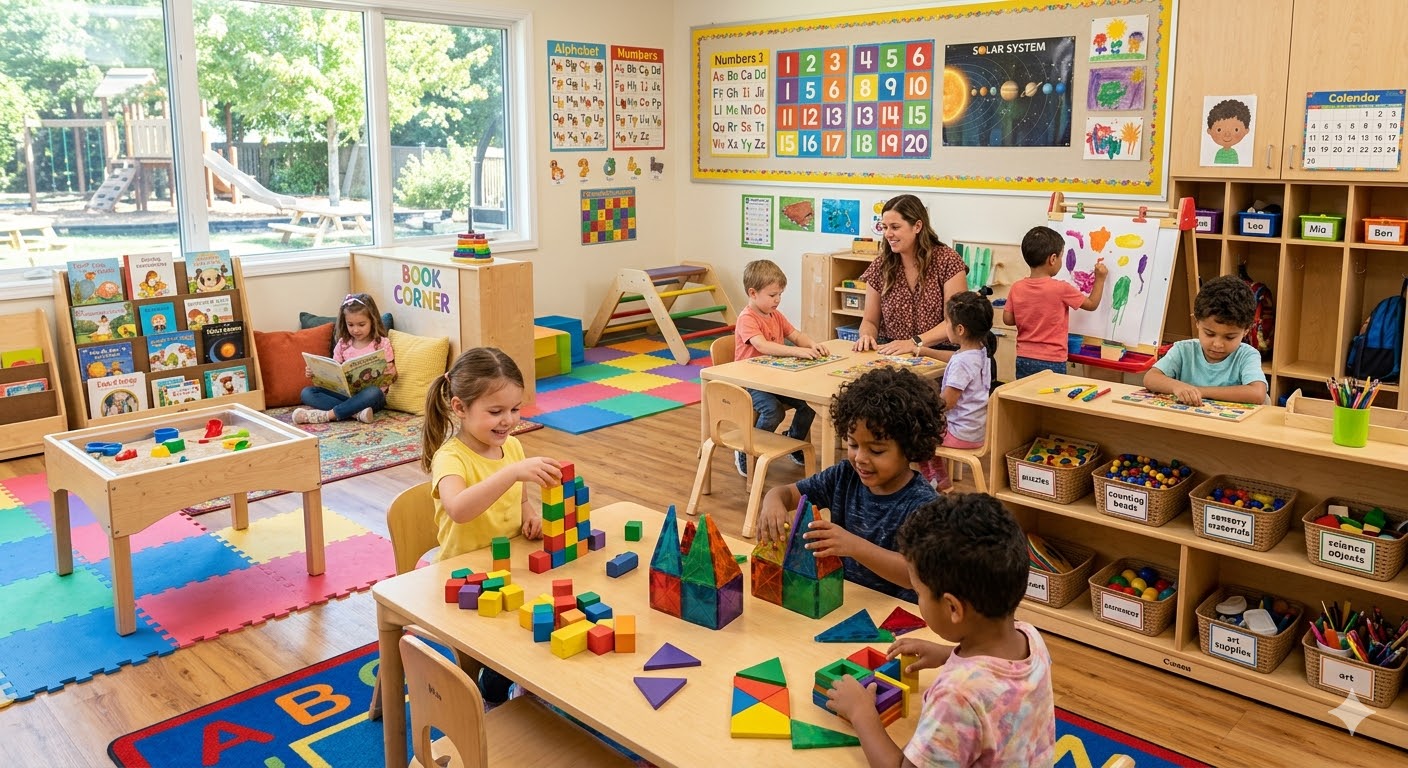
Instead of rows of desks and one-way lectures, our classrooms are active workshops. Children choose meaningful work, handle real materials, and build understanding through their own hands — while teachers observe, guide, and encourage.
Six principles shape every day in our classrooms.
Children choose their own work from a carefully prepared range of activities. Interest drives effort, so concentration and love of learning come naturally.
Golden beads for mathematics, sandpaper letters for language — concrete materials let children touch abstract ideas before they name them.
Everything in the classroom is child-sized, orderly, and within reach. Order in the environment builds order, confidence, and independence in the mind.
Children move, talk, and choose freely — within clear, consistent ground rules. Self-discipline grows from making real choices, not from being told.
Younger children learn by watching older ones; older children lead and mentor. The classroom works like a family, not a batch.
Our trained teachers observe each child closely, present the right lesson at the right moment, and then step back so the child can own the discovery.
The same goals as any good school — reached a gentler, deeper way.
Children learn actively — touching, moving, building and exploring.
Each child progresses at their own pace, without comparison or ranking.
Long, uninterrupted work periods protect deep concentration.
Motivation comes from mastery and joy, not marks and fear.
Children mostly listen and copy while the teacher delivers lessons.
The whole class moves through the same lesson at the same speed.
Learning is broken into short, fixed periods by the bell.
Tests and grades are the main measure of progress.
At M.S. Montessori, each day begins with a long work cycle. Children move through practical life, sensorial, language, and mathematics areas — pouring, sorting, tracing, counting — with teachers presenting new materials one child at a time.
The result is what every parent notices first: calm, busy classrooms full of children who want to be there.
See It in Person arrow_forward